Cost
What drives the price of a geomembrane liner
Nobody can publish a meaningful rate for geomembrane, because the biggest input is a commodity. What you can do is understand the structure of the number.
American specifications say mil. Gulf specifications say millimetres. Chinese mills sometimes say microns. They are the same measurement and mixing them up gets expensive.
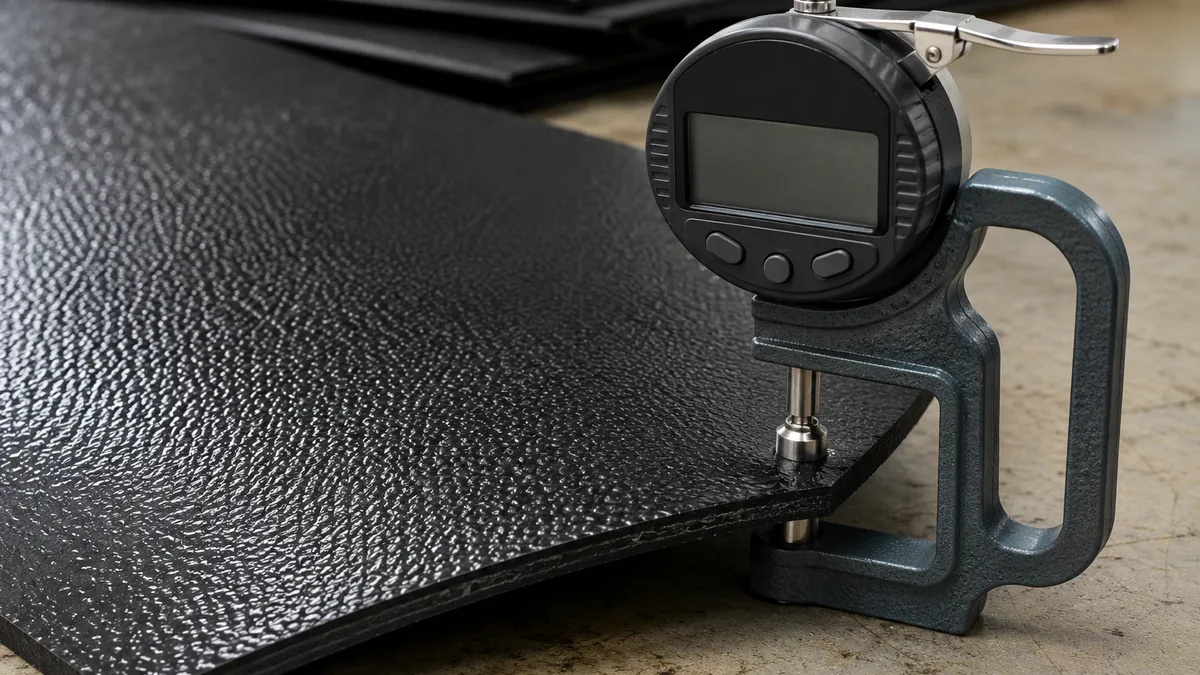
Thickness is the single most quoted property of a geomembrane and the one most often misread, because three different units are in daily use and they differ by three orders of magnitude.
The dangerous confusion is mil against millimetre. A specification asking for 60 mil is asking for 1.5 mm. Someone reading it as 60 mm would be looking for sheet forty times too thick; someone reading it as 0.06 mm would supply agricultural film. Both mistakes have been made.
| mm | mil | microns | Typical use |
|---|---|---|---|
| 0.50 | 20 | 500 | Aquaculture, decorative ponds, temporary bunds |
| 0.75 | 30 | 750 | Farm ponds, small basins, covered applications |
| 1.00 | 40 | 1,000 | Irrigation reservoirs, canal lining, general water storage |
| 1.25 | 50 | 1,250 | Intermediate specification, occasional projects |
| 1.50 | 60 | 1,500 | Wastewater lagoons, landfill base, TSE storage, exposed liners |
| 2.00 | 80 | 2,000 | Industrial containment, leachate ponds, heavy loading |
| 2.50 | 100 | 2,500 | Aggressive chemical containment |
| 3.00 | 120 | 3,000 | Specialist heavy-duty applications |
To convert quickly: mil × 0.0254 = mm, and mm × 39.37 = mil. For rough work, mm × 40 gets you close enough to spot an error.
The gauge is decided by four things: depth of liquid, whether the sheet stays exposed, how rough the subgrade is, and what the basin holds. Depth and exposure are usually the deciding pair. In UAE conditions, 1.5 mm is the practical floor for a permanently exposed liner with real head on it, while 1.0 mm is comfortable if the membrane is covered or permanently submerged.
It is worth noting what thickness does not fix. A thicker sheet on a stony subgrade with no cushion layer still punctures — more slowly, but it still punctures. Thickness and protection are different problems, and spending money on the first while ignoring the second is a common and expensive mistake.
Manufacturing tolerance is real and it is defined: GRI-GM13 permits a small minus tolerance on nominal thickness for smooth sheet. Sheet consistently at the very bottom of tolerance is legitimate; sheet measurably below it is not the product you ordered.
This is where a surprising share of price differences between suppliers actually lives. Ten per cent less material in every roll is ten per cent off the cost base and it is invisible without a gauge. Measure incoming sheet at several points along a roll edge. It takes minutes and it is the most useful quality check a buyer can perform without a laboratory.
Smooth sheet is measured straight across. Textured sheet has raised asperities on one or both faces, and the thickness that matters structurally is the core — the continuous sheet beneath the texture. A supplier quoting thickness measured over the asperities is quoting a bigger number for the same product.
When you specify or compare textured sheet, say “core thickness” explicitly, and check the certificate reports it that way.
Yes. One mil is 0.0254 mm, so 60 mil is 1.524 mm, universally referred to as 1.5 mm sheet.
1.5 mm is the most widely specified gauge for exposed and engineered containment, with 1.0 mm dominating agricultural and general water storage.
Up to a point. More material means more antioxidant reservoir and more tolerance of puncture, so thicker sheet does generally last longer under the same exposure. But UV life is governed mainly by the additive package, and puncture resistance by whether there is a cushion layer — thickness alone does not compensate for either.
Need this specified for a real project? Every gauge in this chart is stock for us as a geomembrane liner supplier in Dubai — send the basin dimensions through the enquiry form and you will get a sheet take-off, a gauge recommendation and a price back.
0.5 to 3.0 mm, smooth and textured, certified core thickness.
Welder settings matched to the actual sheet thickness.
Nobody can publish a meaningful rate for geomembrane, because the biggest input is a commodity. What you can do is understand the structure of the number.
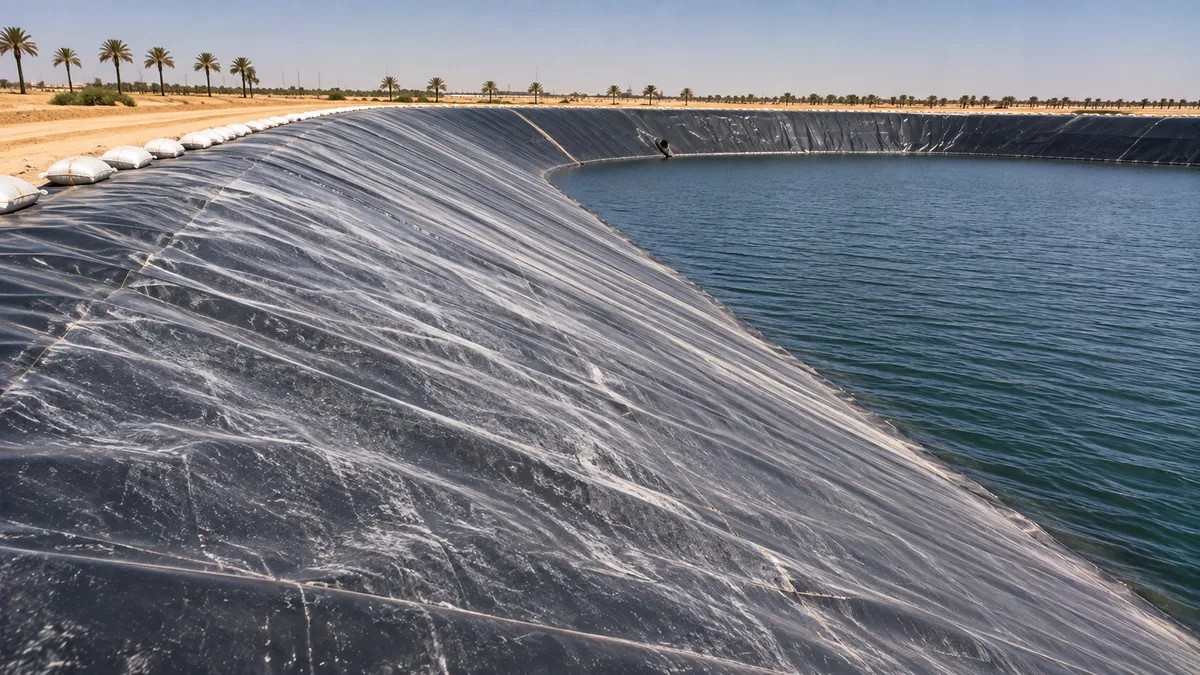
Buried liner is a decades-long asset almost anywhere. Exposed liner in a Gulf summer is a much more interesting question, and the answer depends on things…
Project enquiry
Send it over. We will translate it and quote the equivalent stock gauge.