Stored water
Water reservoir and tank lining
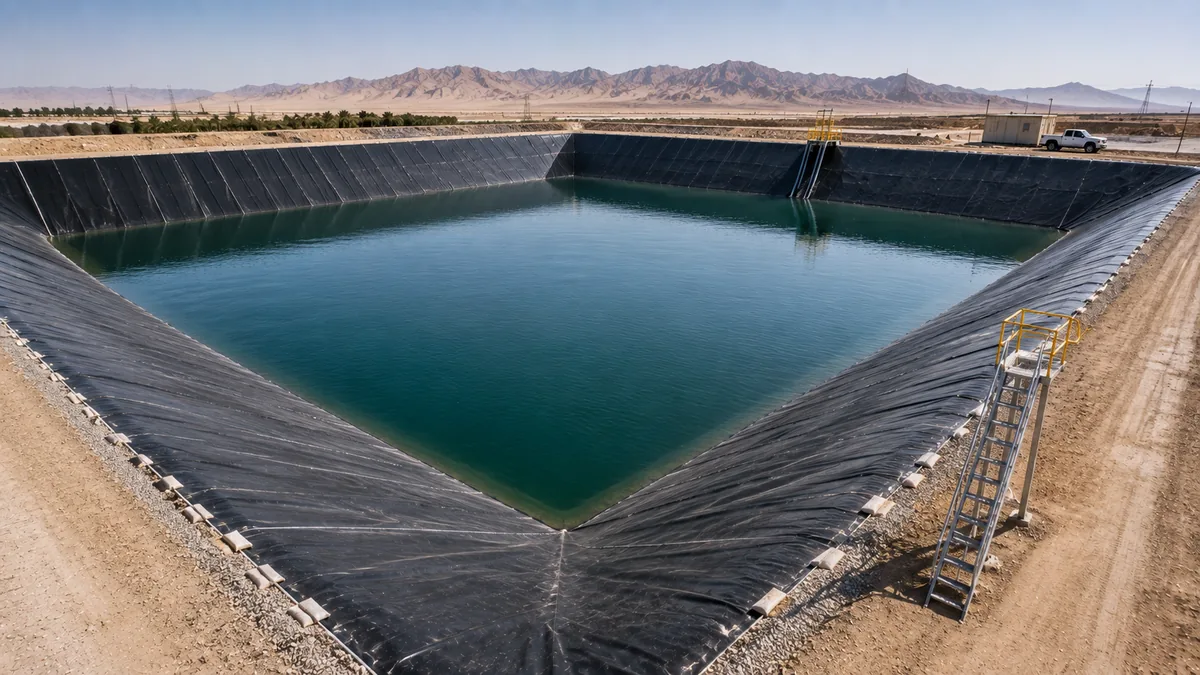
Raw-water reservoirs, firewater basins, TSE storage and lined steel or concrete tanks — sealed with welded HDPE so stored water stays stored.
Stored water in this climate is a managed asset. Whether it is desalinated supply, treated sewage effluent for landscape irrigation, groundwater held for a farm, or a firewater reserve for an industrial site, the storage has to hold what was put into it and keep it clean.
Earth-bank reservoirs
The standard arrangement in the UAE is an excavated or embanked basin lined with 1.0–1.5 mm HDPE. The liner is welded continuous, terminated in a perimeter anchor trench, and detailed around inlet, outlet, scour and overflow structures. Where the reservoir is deep, or the subgrade is gatch or rock, a nonwoven cushion geotextile goes underneath.
Two features are worth designing in from the start. First, a proper access ramp with a protection layer, so that a pump or a cleaning crew never drives directly on the membrane. Second, sufficient freeboard — a reservoir filled to the crest in a shamal will overtop, and water running over the anchor trench erodes it.
Concrete and steel tank lining
Concrete reservoirs that have cracked, and bolted steel tanks that have started to seep at the joints, are frequently lined rather than repaired. The membrane is fixed to the wall with a batten strip and mechanical fixings, with a sealant behind, and welded continuous across the floor. Because there is no sub-liner drainage, the critical detail is preventing water getting behind the membrane and pushing it off the wall — which means the termination detail at the top and the seal at every penetration have to be right.
Potable water
If the reservoir stores drinking water, the sheet needs to be a grade certified for potable contact and the certification needs to come with it. Say so at enquiry stage — it changes what we quote, and it is not something to discover after the rolls are on site.
TSE and irrigation storage
Treated sewage effluent storage for landscape irrigation sits between a clean-water reservoir and a wastewater lagoon. 1.5 mm HDPE is the usual specification, with attention to algae management, gas venting where there is organic load in the water, and the practicalities of pumping out sediment without damaging the liner. Related work is covered on the canal and lagoon lining page.
Cutting evaporation losses
Lining stops seepage; it does nothing about evaporation, which on an open basin through a Gulf summer is a serious number. Where that loss matters, the options are:
- Floating covers. A welded HDPE or LLDPE cover floating on the water surface, with a drainage and rainwater removal arrangement. The most effective option, and the most expensive.
- Suspended shade covers. Structures over the basin. No contact with the water, easier maintenance, lower reduction in loss.
- Surface elements. Floating balls or panels — simple and quick to deploy, moderate effectiveness, and they need retrieving before the basin is cleaned.
Which one makes sense depends on the value of the water and how the basin is operated. We can price a cover alongside the lining if evaporation is the bigger half of your losses.
Firewater and process storage
Firewater basins have a different requirement: the water sits for long periods and must be there in full volume on the day it is needed. Lining is specified for reliability rather than economics, usually 1.5 mm, with inspection access designed in and the liner protected wherever pumps and suction lines enter.
Questions about this service
Can you line a reservoir that is currently full?
No — the basin has to be drained and dried before lining. Where supply cannot be interrupted, reservoirs are sometimes lined in halves with a temporary division, or a second basin is lined first and brought into service. Both are plannable; tell us the operational constraints early.
What thickness for a water reservoir?
1.0 mm covers most covered or shallow storage; 1.5 mm is the working default for exposed reservoirs and TSE storage in the UAE. Depth of water, exposure and subgrade quality decide it — see the thickness guide.
Is HDPE liner safe for drinking water storage?
Potable-grade HDPE sheet certified for drinking water contact is available and is what we supply for potable applications. Tell us at enquiry stage so the correct grade and certification are quoted.
Can a liner be installed inside an existing concrete tank?
Yes. The membrane is battened to the walls with fixings and sealant and welded continuous over the floor. It is a common and durable repair for cracked concrete reservoirs.
Do floating covers work in UAE conditions?
They are effective at cutting evaporation, but they are engineered systems — they need rainwater removal, wind detailing and access for maintenance. A cover designed properly lasts; one thrown over a basin does not.
Project enquiry
Ready to price the job?
Dimensions, depth and what the basin will hold — that is enough to start.