Environmental containment
Landfill liner systems
Base liners, sidewall anchoring, leachate collection and capping systems built to the layer sequence your specification calls for, with CQA documentation to match.
Landfill lining is the most heavily specified work a geomembrane installer does, and rightly so — the liner is the only thing between leachate and groundwater. Everything here is governed by the project specification and the CQA plan, and our job is to build exactly what is drawn and prove that we did.
The base liner build-up
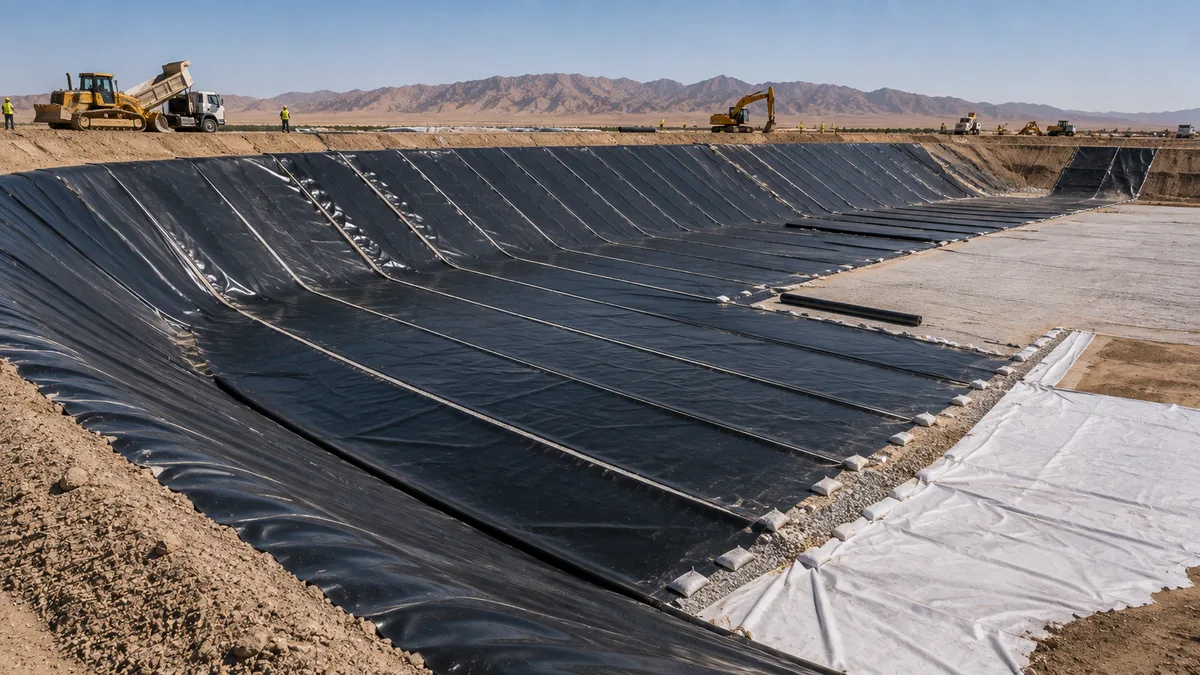
A composite base liner is a sequence, not a single product. Working upward from the prepared subgrade, a typical arrangement is:
| Layer | Component | Function |
|---|---|---|
| 1 | Prepared and compacted subgrade | Uniform support, no sharp material |
| 2 | Compacted clay liner or geosynthetic clay liner (GCL) | Second low-permeability barrier |
| 3 | HDPE geomembrane, typically 1.5–2.0 mm, textured on slopes | Primary barrier |
| 4 | Protection geotextile | Shields the membrane from the drainage stone |
| 5 | Drainage layer — gravel or geocomposite | Collects and conveys leachate to the sump |
| 6 | Separation geotextile | Keeps waste out of the drainage layer |
Textured sheet is used on the sidewalls so the interface friction holds the overlying layers; smooth sheet is used on the floor where friction is not needed and welding is easier. The interface friction angles between each pair of layers are what the slope stability analysis depends on, which is why substituting a component — a different geotextile, a different texture — is a design change, not a procurement decision.
Leachate collection and the sump
The sump is the most detailed part of the whole cell: a locally deepened area, a thickened protection layer, a riser pipe passing through the lining, and a pump. Every one of those elements is a penetration through the primary barrier and every one is extrusion-welded, boot-detailed and individually tested. Detail work here is slow and it should be.
Sidewalls and anchoring
Membrane on the sidewalls is terminated in a perimeter anchor trench at the crest. On tall or steep sidewalls, intermediate benches with additional anchor trenches take load out of the sheet so that a long panel is not carrying its full self-weight plus the drainage layer at a single termination.
Capping and closure
A closure cap is the base liner problem in reverse: it keeps rain out of the waste rather than leachate in. Because the waste mass beneath continues to settle, and settles unevenly, caps are frequently built with LLDPE rather than HDPE — the greater elongation lets the membrane follow settlement without tearing. A cap typically carries a gas venting layer beneath the membrane, the membrane itself, a drainage layer above it, and a soil cover thick enough to protect it and support vegetation.
CQA and documentation
Construction quality assurance is the deliverable, alongside the physical works. That means trial welds recorded per welder per shift, air-pressure testing of every wedge seam, vacuum testing of every extrusion weld, destructive coupons at the specified frequency with peel and shear results, panel and seam registers keyed to an as-built drawing, subgrade acceptance records, and material conformance certificates for every roll delivered. Where the specification calls for an electrical leak location survey after the protection layer is placed, we arrange it.
See also our note on installation and seam testing for how the welding and testing regime works in practice.
Questions about this service
What thickness is used for a landfill base liner?
1.5 mm and 2.0 mm HDPE are the usual specifications, with the choice driven by the regulator, the waste type and the depth of waste above. Sidewalls are normally textured, floors normally smooth.
Do you install GCL and drainage geocomposite as well?
Yes. Composite lining systems are installed as one package — GCL, geomembrane, protection and separation geotextiles and drainage geocomposite — because the interfaces between them matter as much as the components.
Why is LLDPE used for capping?
Because a closure cap has to deform. Waste settles unevenly for years after closure, and LLDPE's much higher elongation lets the membrane follow that movement where an HDPE sheet would concentrate strain and tear.
Can you work to a third-party CQA consultant?
Routinely. Independent CQA is normal on landfill works, and our records, hold points and test frequencies are set up to be audited by someone else.
Project enquiry
Ready to price the job?
Dimensions, depth and what the basin will hold — that is enough to start.