HDPE Geomembrane Liner Supply
Smooth and textured HDPE sheet from 0.5 mm to 3.0 mm in 7 m rolls, supplied to GRI-GM13.
View serviceHDPE · LLDPE · Geotextile
Impermeable HDPE liner sheet from 0.5 mm to 3.0 mm, cut and welded for reservoirs, ponds, canals, lagoons and landfill cells. Supply only, or supply with a welding crew on site — anywhere in the Emirates.
What we do
Two ways to buy. Take the sheet only and weld it with your own crew, or hand over the whole containment package — take-off, panel layout, deployment, welding, testing and as-built records. Both start from the same stock: virgin-resin HDPE geomembrane in 7 metre rolls.
Smooth and textured HDPE sheet from 0.5 mm to 3.0 mm in 7 m rolls, supplied to GRI-GM13.
View serviceHot-wedge and extrusion welding by trained crews, with air-pressure and vacuum-box testing on every seam.
View serviceFarm ponds, aquaculture basins and decorative lakes lined with HDPE or LLDPE geomembrane sheet.
View serviceIrrigation canals, evaporation ponds and wastewater lagoons lined to stop seepage losses.
View serviceBase liners, capping systems and leachate containment built to municipal specification.
View serviceRaw-water reservoirs, firewater tanks and TSE storage lined with potable-grade sheet.
View serviceNonwoven cushion geotextile, geocell, drainage composite and HDPE geocomposite supply.
View serviceSpecification
Thickness is the first decision on any lining job, and it is decided by three things: the depth of liquid sitting on the membrane, whether the sheet is left exposed to the sun, and how rough the prepared subgrade is. Everything else — roll length, smooth versus textured, colour — follows from the layout and the side slopes.
| Thickness | Mil | Roll width | Typical application |
|---|---|---|---|
| 0.50 mm | 20 mil | 7.00 m | Aquaculture ponds, decorative water features, temporary bunds |
| 0.75 mm | 30 mil | 7.00 m | Farm ponds, small irrigation reservoirs, nursery basins |
| 1.00 mm | 40 mil | 7.00 m | Irrigation reservoirs, canal lining, general water storage |
| 1.50 mm | 60 mil | 7.00 m | Wastewater lagoons, landfill base liners, TSE storage |
| 2.00 mm | 80 mil | 7.00 m | Industrial containment, leachate ponds, heavy-traffic subgrades |
| 2.50 – 3.00 mm | 100 – 120 mil | 6.00 – 7.00 m | Aggressive chemical containment and specified heavy-duty works |
Standard rolls run 7 m wide by 105 m or 140 m long depending on gauge, which is the practical limit for handling with a telehandler on a UAE site. Textured sheet, single or double sided, is used where slopes are steeper than roughly 1V:3H so that the interface friction holds the panel and any soil cover in place. Black is the standard colour; white-surfaced sheet is available where surface temperature or glare on an exposed liner is a concern.
Full gauge-by-gauge detail, mil conversions and roll weights are set out on the geomembrane thickness and roll size page.
Applications
Water is expensive here and ground conditions are permeable. Almost every application below comes down to the same problem: keeping liquid where it was put.
Date farms and landscape contractors in Al Ain and the western region lose a large share of stored water to seepage through sandy subgrade. A 1.0 mm lined basin holds it.
Reservoir liningSmooth HDPE or flexible LLDPE, welded continuous, with rounded corners and a protected inlet so nets and stock are not damaged.
Pond linerTreated sewage effluent storage and balancing lagoons, normally 1.5 mm sheet with a geotextile cushion and gas-vent detailing.
Lagoon liningBase liners, sidewall anchoring and capping systems for municipal waste, built to the layer sequence in the project specification.
Landfill linerOpen irrigation channels and stormwater diversions lined to cut infiltration losses and stop bank erosion.
Canal liningChemical bunds, wash-down areas, tank farms and temporary storage pads where a spill must not reach the ground.
Liner supply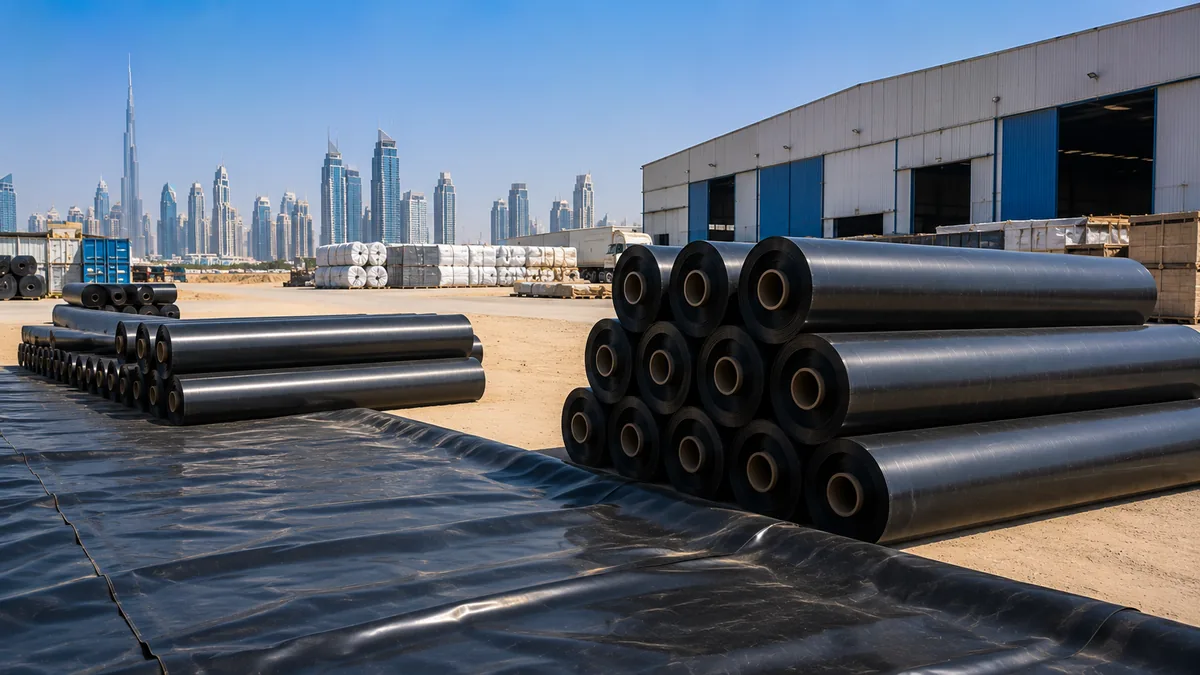
How a lining job runs
The order matters. Most lining failures trace back to a stage that was rushed — usually subgrade preparation or seam testing.
We measure the basin, check side-slope angles and calculate sheet quantity including overlaps, anchor trench and wastage.
The base is graded, compacted and cleared of stones and roots. Anchor trenches are cut around the crest.
Where the subgrade is rocky or the head is high, a nonwoven geotextile is laid to protect the membrane from puncture.
Rolls are positioned by slope direction, unrolled to the panel layout and temporarily ballasted against wind uplift.
Panels are joined by hot-wedge dual-track weld; details, patches and pipe boots are finished by extrusion welding.
Every seam is air-pressure or vacuum-box tested, trenches are backfilled, and you receive the QC log and as-built panel layout.
Material choice
HDPE is the default. It is the most chemically resistant of the common liner polymers, it handles UV better than anything else at the price, and it welds cleanly. The trade-off is stiffness: HDPE has a low strain limit, so it does not like differential settlement or fiddly geometry, and it needs slack left in the panels for thermal expansion.
LLDPE is the flexible alternative. Lower tensile strength, far higher elongation, which makes it the sensible choice over soft or settling ground, in small basins with many corners, and for closure caps that have to deform with the waste mass underneath.
PVC and LDPE sheet appear in garden ponds and short-term applications. They are cheap and easy to handle, but PVC degrades under direct Gulf sun unless it is covered, so it is not a material we recommend for an exposed reservoir here.
If the project has a specification, follow it. If it does not, tell us the head of liquid, whether the liner stays exposed, and what the subgrade is, and we will tell you what the sheet needs to be. There is a longer comparison in the guide on HDPE vs LLDPE vs PVC geomembrane.
Coverage
Deliveries and installation crews across the country. Pick your emirate for local project notes — ground conditions, typical works and the gauges usually specified there.
As HDPE liner suppliers in UAE we hold stock rather than order against each job, so geomembrane Dubai deliveries usually leave within a day of a confirmed order, and the northern emirates and Al Ain follow on the same run. HDPE liner installation is handled by our own welding crews rather than subcontracted, which is why the seam test records that reach you carry the same reference as the delivery note. Whether you need geomembrane UAE-wide for a programme of basins or one roll for a single farm pond, the sheet, the cushion geotextile and the welding come from one place.
Budget
Sheet price moves with polyethylene resin cost, thickness and order volume, so any figure quoted without a date is meaningless. What is stable is the shape of the cost: roughly 60–75 per cent of a supplied liner price is raw resin, and installed rates add welding labour, plant, testing and anchor-trench earthworks on top of the sheet.
The geomembrane liner price page explains the variables and what typically moves a quotation up or down, so you can sanity-check the numbers you are given.
Questions
A geomembrane liner is a synthetic sheet with very low permeability that is used as a barrier to stop liquid or gas moving through soil. In the UAE the sheet is normally high-density polyethylene (HDPE), rolled out over a prepared subgrade and heat-welded panel to panel so the finished lining behaves as one continuous membrane. Permeability of HDPE sheet is in the order of 10-13 cm/s, which is why it is specified for reservoirs, lagoons and landfill cells rather than clay or concrete alone.
HDPE sheet itself is effectively impermeable — water does not pass through the polymer in any meaningful volume. What decides whether the finished basin holds water is the seams and the details. Panels joined with a correctly set dual-track wedge weld, tested by air pressure, and terminated in a proper anchor trench will hold; the same sheet installed with cold laps, unsealed pipe penetrations or an untested extrusion weld will not. This is why installation and welding matters more than the sheet grade on most projects.
As a working rule for UAE projects: 0.5–0.75 mm for aquaculture and decorative ponds, 1.0 mm for farm and irrigation reservoirs, 1.5 mm for wastewater lagoons, TSE storage and landfill base liners, and 2.0 mm where there is chemical loading or plant traffic on the lining. Head of liquid, exposure to sun and the roughness of the subgrade all push the specification upward. The full breakdown is on the thickness and roll size page.
“Pond liner” describes the job; “geomembrane” describes the material. Most pond liners sold in the UAE are geomembranes — usually HDPE or LLDPE sheet. The difference you will notice in practice is grade: a light PVC or LDPE pond liner sold by the metre suits a garden feature, while a welded HDPE geomembrane is what a contractor uses for an irrigation reservoir or a fish farm that has to last decades in direct sun.
Buried HDPE geomembrane has a design life measured in decades. Exposed sheet in Gulf conditions is the harder case: carbon black loading and antioxidant packages are what carry the membrane through continuous UV and surface temperatures that regularly exceed 70 °C on a black liner in summer. A 1.5 mm exposed liner specified to GRI-GM13 and installed with proper slack for thermal movement is generally expected to serve well beyond 20 years; covering the liner with soil or water extends it considerably.
Yes. Sheet is delivered and crews mobilise to Dubai, Abu Dhabi, Sharjah, Ajman, Ras Al Khaimah, Fujairah, Umm Al Quwain and Al Ain. Send the basin dimensions through the enquiry form and you will get a quantity take-off and price back.
Project enquiry
Length, width, depth, slope angle and whether the sheet stays exposed — that is all we need to price the sheet and, if you want it, the welding crew with it.