Field notes
Geomembrane work across the UAE, emirate by emirate
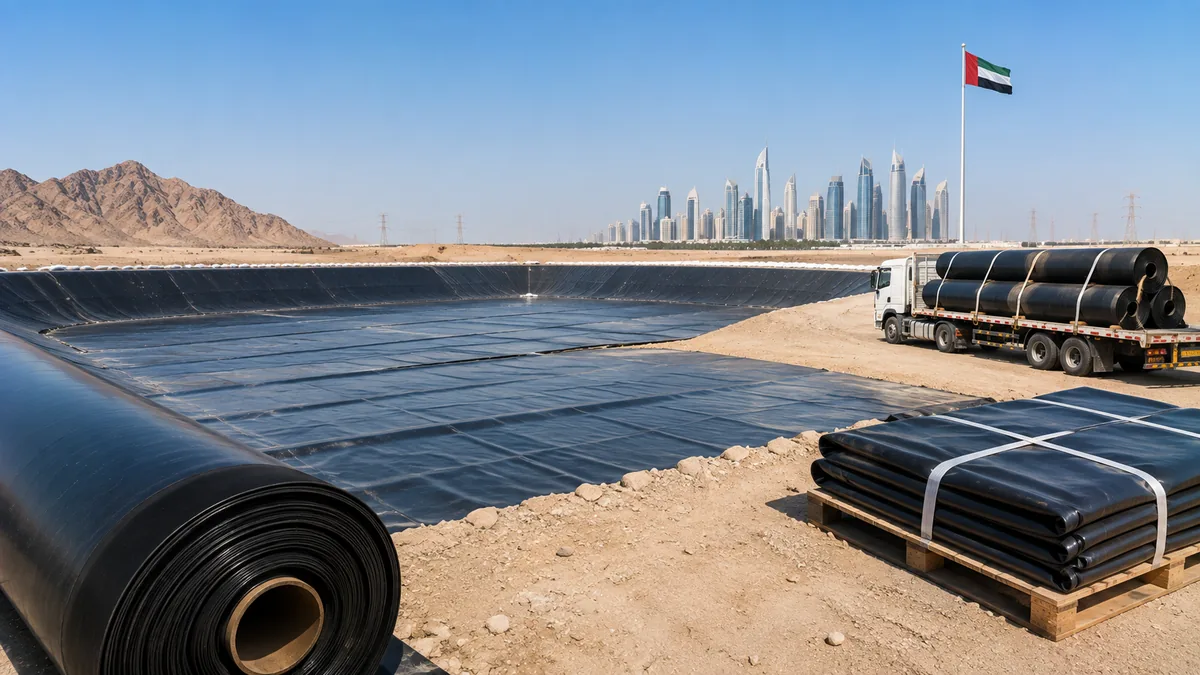
The country is small enough that one stockholding serves all of it, and varied enough that the lining job in Ras Al Khaimah is nothing like the one in Al…
Most liner leaks are not seam failures. They are punctures made after the seams passed — which is why the testing regime has more than one method in it.
A common assumption is that liner leaks are welding failures. Studies of installed linings have consistently found the opposite: the majority of holes in a finished geomembrane are punctures and installation damage, not defective seams. Which shapes what a sensible testing regime looks like.
The workhorse for wedge welds. A dual-track seam has an unwelded air channel running between its two welded tracks. Seal both ends, insert a needle, pressurise to the specified value, and hold. If pressure holds within the allowance, the seam is continuous along its entire tested length.
This is the only routine method that tests a whole seam rather than a point on it, which is exactly why specifications insist on dual-track wedge welding for production seams. One detail matters: at the end of the test, the far end is cut open to confirm the pressure was actually travelling down the channel. Without that check, a blocked channel reads as a perfect seam.
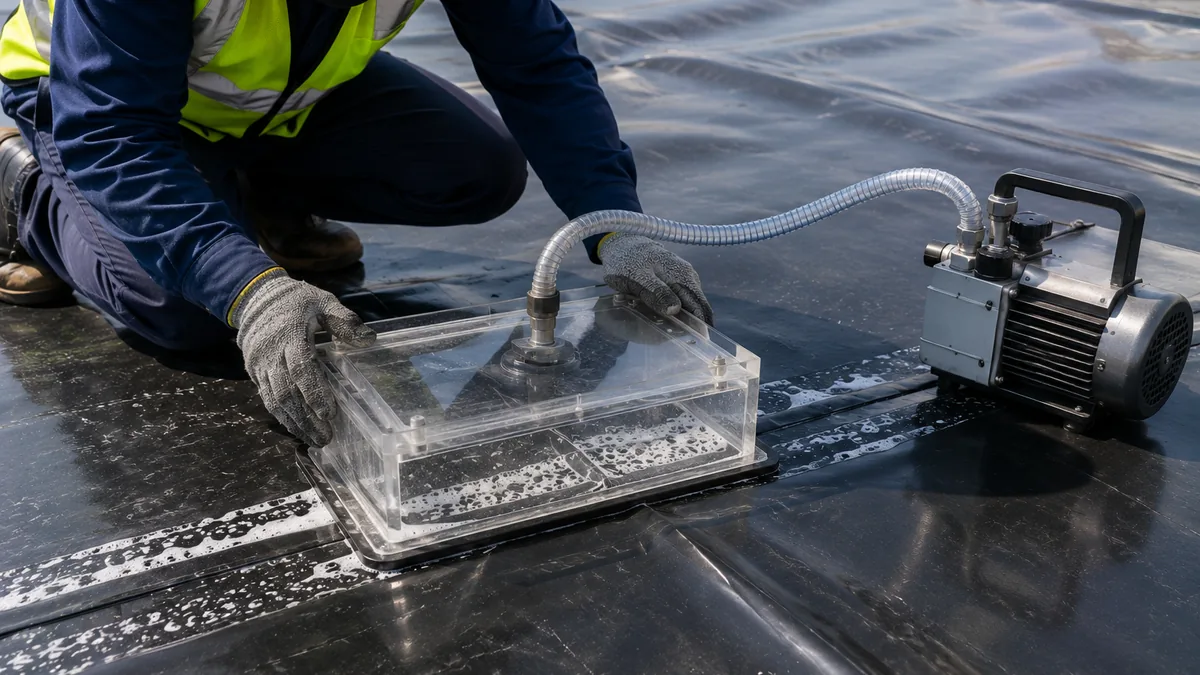
Extrusion welds have no air channel and are tested differently. A vacuum box — a rigid frame with a transparent top and a soft gasket — is placed over a soaped section of weld and a partial vacuum drawn. Any through-hole pulls air in and produces bubbles.
Spark testing is the alternative where a vacuum box cannot seal, such as on complex detail work. A conductive wire is laid into the weld and a high-voltage probe passed over the finished bead; a hole completes the circuit and sparks. Both are point-by-point methods — the operator has to cover the whole weld, and the record is only as good as the coverage.
The only test that measures bond strength rather than absence of a hole. A coupon is cut from a live seam at a specified frequency, divided into strips, and pulled in peel and shear on a field tensiometer. The requirement is not simply a number: the seam must fail in the parent sheet, not at the bond. A specimen that separates along the weld interface fails regardless of the load recorded.
The hole left behind is patched by extrusion weld and vacuum tested like any other repair.
The method that finds what seam testing cannot. It exploits the fact that an intact geomembrane is an insulator: a voltage is applied across it, and current can only flow where there is a hole. An operator sweeps the surface with probes and the current concentration identifies the defect.
Two versions are common. The water puddle method is used on exposed liner, with a wetted surface. The covered liner method surveys after soil or drainage stone has been placed, which is far more valuable because that placement is when much of the damage happens. A survey after covering routinely finds holes that were not there when the seams passed.
It is an additional cost, and on any project where a leak would be expensive or environmentally serious it is money well spent.
An existing lining that has started losing water is a different problem. Sequence:
The economics favour looking early. A puncture found in the first year is a patch; the same puncture found in year five has taken a great deal of water with it.
Start by confirming the loss is seepage rather than evaporation, then inspect penetrations, anchor trench and access points, which account for most leaks. If that does not find it, an electrical leak location survey will — it can be run on an exposed liner, a water-covered liner, or a liner under soil cover.
The project specification sets it, commonly one sample per set length of seam per welding machine. It is a balance: coupons prove bond strength but each one puts a hole in a good seam that then has to be patched.
Yes — that is exactly what the covered-liner electrical leak location method is for, and it is the most useful time to survey, because placing cover material is when a lot of damage occurs.
Need this specified for a real project? Testing and documentation come as standard on the lining works we carry out across the UAE — send the basin dimensions through the enquiry form and you will get a sheet take-off, a gauge recommendation and a price back.
Every seam air or vacuum tested, every result logged.
Full CQA regimes including leak location surveys.
The country is small enough that one stockholding serves all of it, and varied enough that the lining job in Ras Al Khaimah is nothing like the one in Al…
Two quotations for the same basin can differ by half, and both can be for something described as “1.5 mm HDPE geomembrane”. Here is what…
Project enquiry
Tell us what you are seeing and how the basin is built. We will suggest where to look first.