Specification
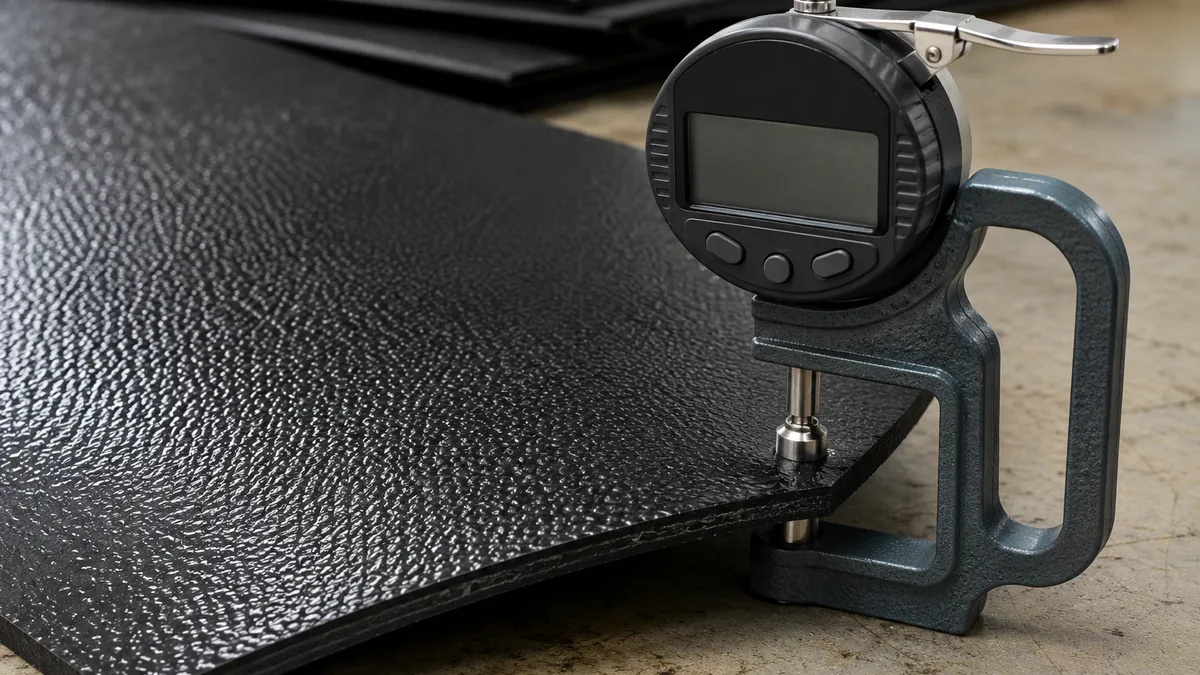
Geomembrane thickness: mm, mil and microns without the confusion
American specifications say mil. Gulf specifications say millimetres. Chinese mills sometimes say microns. They are the same measurement and mixing them…
It is a fabric that costs a fraction of the membrane above it, and leaving it out is the most expensive saving on most lining projects.
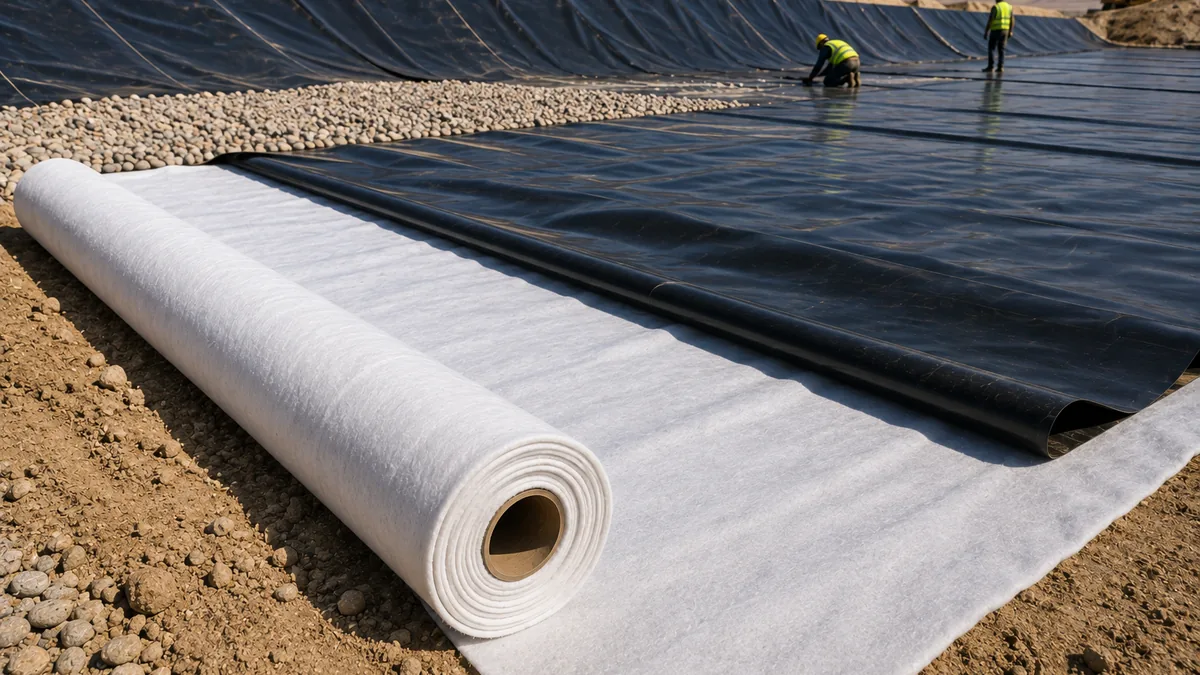
Every lining project has a line item that gets deleted when the budget is tight, and it is almost always the geotextile. The membrane is obviously essential; the fabric under it looks like an optional extra. It is not, and the consequence of deleting it does not appear for several years, which is precisely what makes the false economy so easy to commit.
A geomembrane under a head of water is pressed down onto whatever is beneath it, hard. Every stone, every angular piece of gatch, every bit of construction debris becomes a point load. The sheet does not puncture immediately — polyethylene is tough — but under sustained load it thins locally, and over months and years that thinning becomes a hole.
A nonwoven needle-punched geotextile spreads those point loads. It is thick, compressible and permeable, so it distributes the pressure from a single stone across a much larger area of membrane, and it deforms around the stone rather than transmitting its shape.
You can lay a geomembrane straight on the subgrade when the subgrade is fine-grained, graded, compacted and genuinely stone-free — clean sand that has been rolled and hand-picked. That is a real condition and plenty of UAE sites meet it.
A cushion layer is needed when any of the following is true:
In practice that covers most projects in Ras Al Khaimah, Fujairah and the inland gravel plains, and a good share of everything else.
| Mass | Where it fits |
|---|---|
| 200 g/m² | Separation, light protection over graded sand |
| 300 g/m² | General-purpose cushion under pond and reservoir liners |
| 400 g/m² | Gatch and gravelly subgrades, deeper basins |
| 500 g/m² + | Rock subgrade, or protection beneath a drainage stone layer |
Mass per unit area is the usual specifying parameter because it correlates with thickness and with protection performance. On critical projects the protection is verified by test rather than assumed — a cylinder test that loads the actual membrane-and-geotextile combination against the actual subgrade material.
The same logic applies in the other direction. If gravel, drainage stone, concrete or a soil cover is going onto the membrane, it needs protecting from that as well. On landfill work the protection geotextile above the liner is frequently heavier than the cushion below it, because a placed drainage stone layer is a far more aggressive loading than a prepared subgrade.
It is not a barrier. Geotextile is permeable by design — it filters, separates, drains and protects, and water passes straight through it. Occasionally someone orders geotextile expecting it to line a pond. It will not. The barrier is the geomembrane; the geotextile is what keeps the barrier intact.
300 g/m² is the general-purpose answer for pond and reservoir basins. Move up to 400–500 g/m² for gatch, gravel or rock subgrades and for deeper basins.
No. Geotextile is permeable and does not hold water. It protects, separates and drains; the geomembrane is what provides the barrier.
Either, and often both. Below as a cushion against the subgrade, above as protection where stone, gravel or soil cover is placed on the membrane.
Need this specified for a real project? We supply cushion geotextile alongside the sheet as HDPE geomembrane suppliers in the UAE — send the basin dimensions through the enquiry form and you will get a sheet take-off, a gauge recommendation and a price back.
Nonwoven cushion, drainage composite, geocell and geogrid.
Sheet and cushion layer delivered together, on one order.
American specifications say mil. Gulf specifications say millimetres. Chinese mills sometimes say microns. They are the same measurement and mixing them…
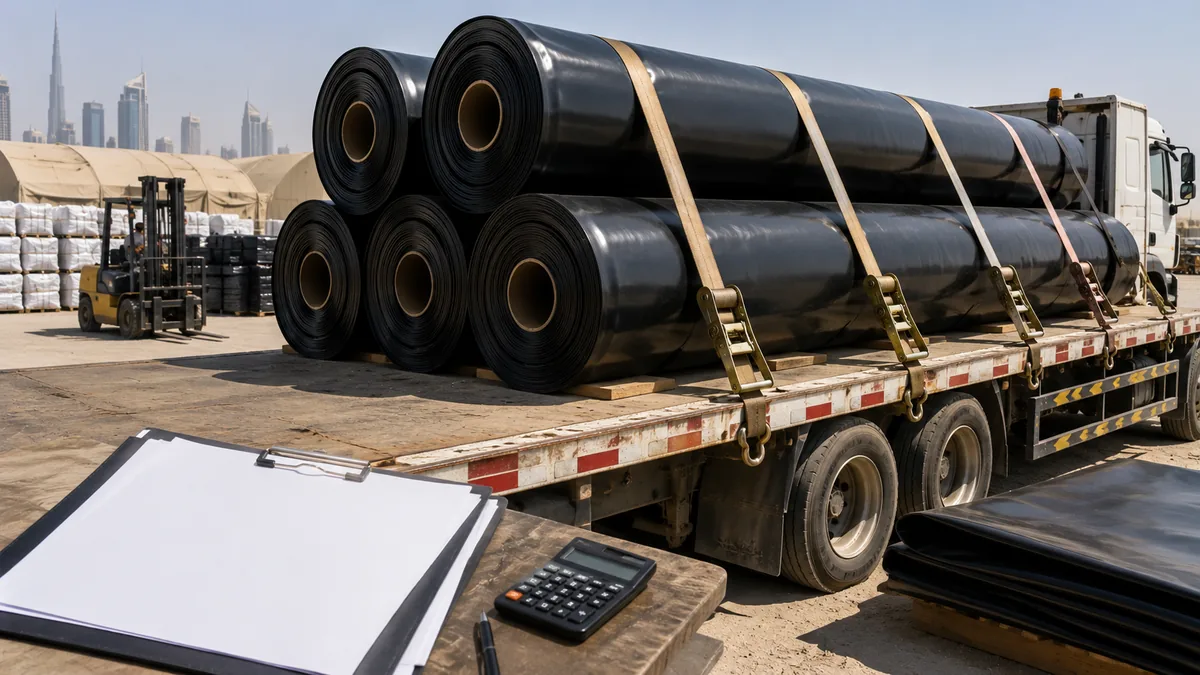
Nobody can publish a meaningful rate for geomembrane, because the biggest input is a commodity. What you can do is understand the structure of the number.
Project enquiry
Describe what is under the basin and we will tell you what mass of cushion geotextile it needs.