Agriculture
Lining irrigation reservoirs: what it saves a UAE farm
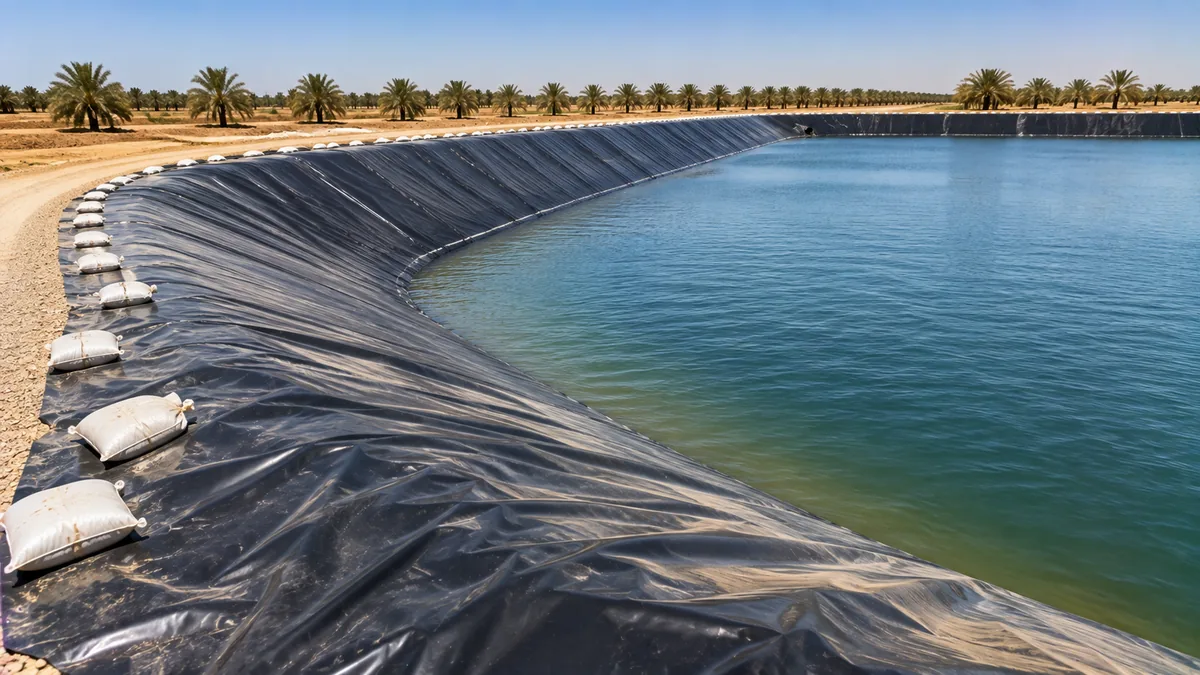
A farm reservoir on sand loses water two ways at once. Telling the two apart is the first step, because only one of them is fixed by lining.
A landfill liner is not a sheet. It is a sequence of layers, each doing one job, and the interfaces between them decide whether the slope stands up.
Municipal waste generates leachate — rainwater and moisture that has percolated through waste and picked up whatever was in it. A landfill liner exists to keep that liquid out of groundwater, and to collect it so it can be treated. Everything about the design follows from those two requirements.
Four jobs at once: form a barrier, collect and convey leachate to a pump, survive being built on by heavy plant, and stay stable on the sidewall slopes while a growing mass of waste presses on it. No single material does all four, which is why it is a composite.
| # | Layer | Job |
|---|---|---|
| 1 | Prepared subgrade | Uniform, compacted, no sharp material |
| 2 | Compacted clay or geosynthetic clay liner (GCL) | Second low-permeability barrier beneath the membrane |
| 3 | HDPE geomembrane, 1.5–2.0 mm | Primary barrier — textured on slopes, smooth on the floor |
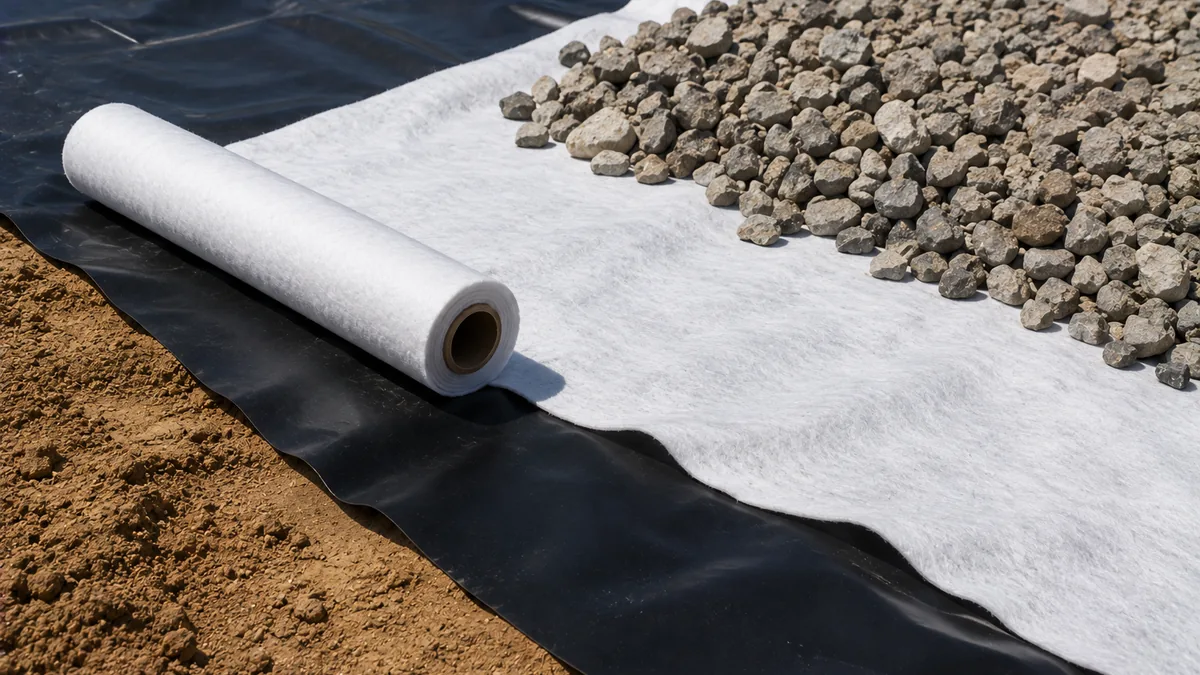
| 4 | Protection geotextile | Stops the drainage stone puncturing the membrane |
| 5 | Drainage layer — gravel or geocomposite | Conveys leachate to the sump |
| 6 | Separation geotextile | Keeps waste fines out of the drainage layer |
The clay or GCL beneath the membrane is not redundancy for its own sake. If the geomembrane is ever breached, the low-permeability layer immediately below dramatically slows what gets through, and the two together perform far better than either alone — provided they are in intimate contact, which is why a GCL is laid tight and the membrane placed directly on it.
Leachate flows down the graded floor through the drainage layer to a sump — a locally deepened area with a thickened protection layer, a riser pipe and a pump. The sump is the most detail-heavy part of the cell: several penetrations through the primary barrier, each one extrusion-welded, boot-detailed and individually tested.
The drainage layer has to keep working for decades. Gravel clogs with fines and biological growth, which is why the separation geotextile above it is not optional, and why the layer is designed with capacity well beyond the calculated flow.
On a sidewall, everything above the membrane is trying to slide down it. Whether it does depends on the friction angle at each interface — geomembrane to GCL, geomembrane to geotextile, geotextile to drainage stone. Those angles are measured values for a specific pair of products, and the slope stability analysis is built on them.
Which is why substituting a component is a design change, not a purchasing decision. A geotextile from a different supplier with the same stated mass can have a different interface friction angle against your membrane. If a substitution is proposed, it needs testing or it needs the designer's approval.
This is also why sidewalls use textured sheet and floors generally use smooth: texture buys friction where friction is what is holding the system up, and smooth sheet is easier to weld where it is not needed.
A cap is the base liner inverted. Its job is keeping rainwater out of the waste, so that leachate generation drops after closure, and controlling landfill gas. A typical build-up from the waste upward is: regulating layer, gas collection layer, geomembrane, drainage layer, then soil cover deep enough to protect the membrane and support vegetation.
Caps are frequently built with LLDPE rather than HDPE. Waste settles for years after closure and it settles unevenly; LLDPE's much greater elongation lets the membrane follow that movement where HDPE would concentrate strain at the low points and tear.
Construction quality assurance is a deliverable in its own right. On a landfill cell it means subgrade acceptance records before any liner is placed, material conformance certificates for every roll, trial welds per welder per shift, air-pressure testing of every wedge seam, vacuum testing of every extrusion weld, destructive coupons at the specified frequency, and a panel and seam register keyed to an as-built drawing. Many projects add an electrical leak location survey once the protection layer is placed, because that survey finds installation damage that no seam test can.
The file is what the regulator reads. If it is incomplete, the works are incomplete, whatever the site looks like.
1.5 mm and 2.0 mm HDPE are standard for base liners, driven by regulatory requirement, waste type and depth of waste above. Sidewalls are normally textured, floors smooth.
A geosynthetic clay liner is a thin layer of bentonite between geotextiles that swells on contact with water to form a very low-permeability barrier. It is used as the second barrier beneath a geomembrane where a compacted clay layer is impractical — which in the UAE, where suitable clay is scarce, is often.
Because closure caps have to deform as the waste beneath settles. LLDPE stretches far further than HDPE before failing, so it follows differential settlement instead of tearing over it.
Need this specified for a real project? We install composite lining systems as HDPE geomembrane specialists working across the UAE — send the basin dimensions through the enquiry form and you will get a sheet take-off, a gauge recommendation and a price back.
Base liners, sumps, sidewall anchoring and capping, with CQA.
Protection and separation geotextile, GCL and drainage geocomposite.
A farm reservoir on sand loses water two ways at once. Telling the two apart is the first step, because only one of them is fixed by lining.
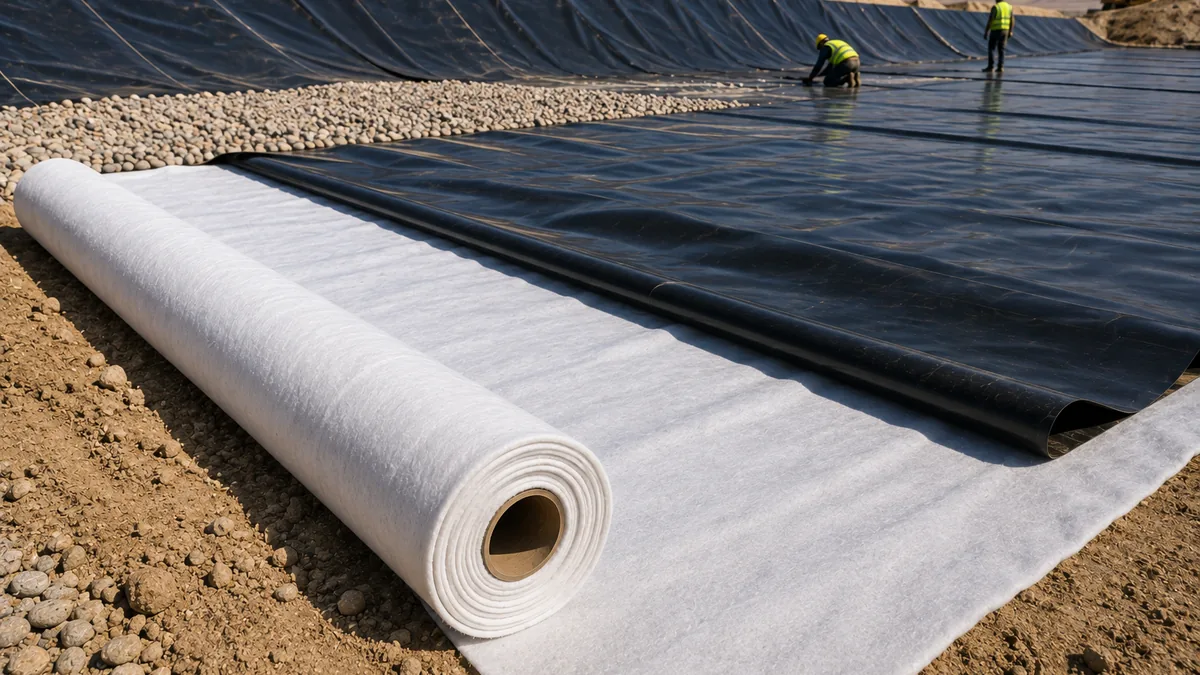
It is a fabric that costs a fraction of the membrane above it, and leaving it out is the most expensive saving on most lining projects.
Project enquiry
Send the specification and drawings. We will price the lining package and the CQA scope with it.