Water management
Canal lining: how much water an unlined channel loses
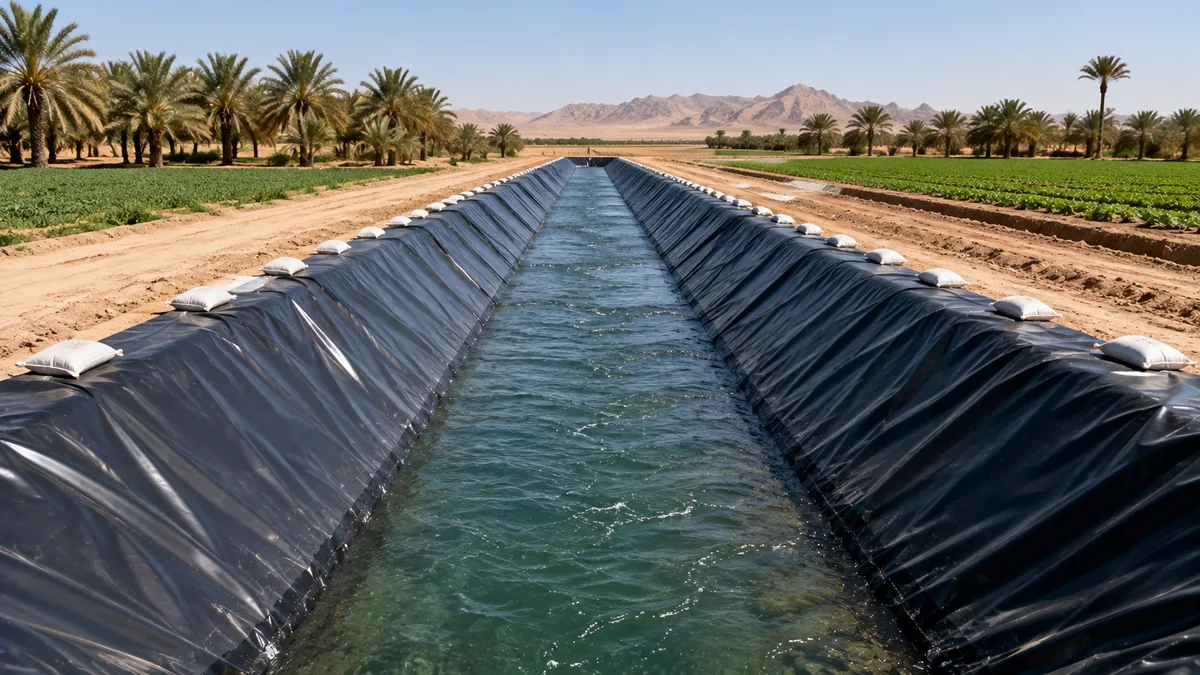
Seepage from an open channel is invisible. There is no leak to point at — just water that arrives at the far end in smaller quantity than it left.
The sheet is the easy part. Everything that decides whether a pond holds water happens before the first roll comes off the truck and after the last seam is welded.
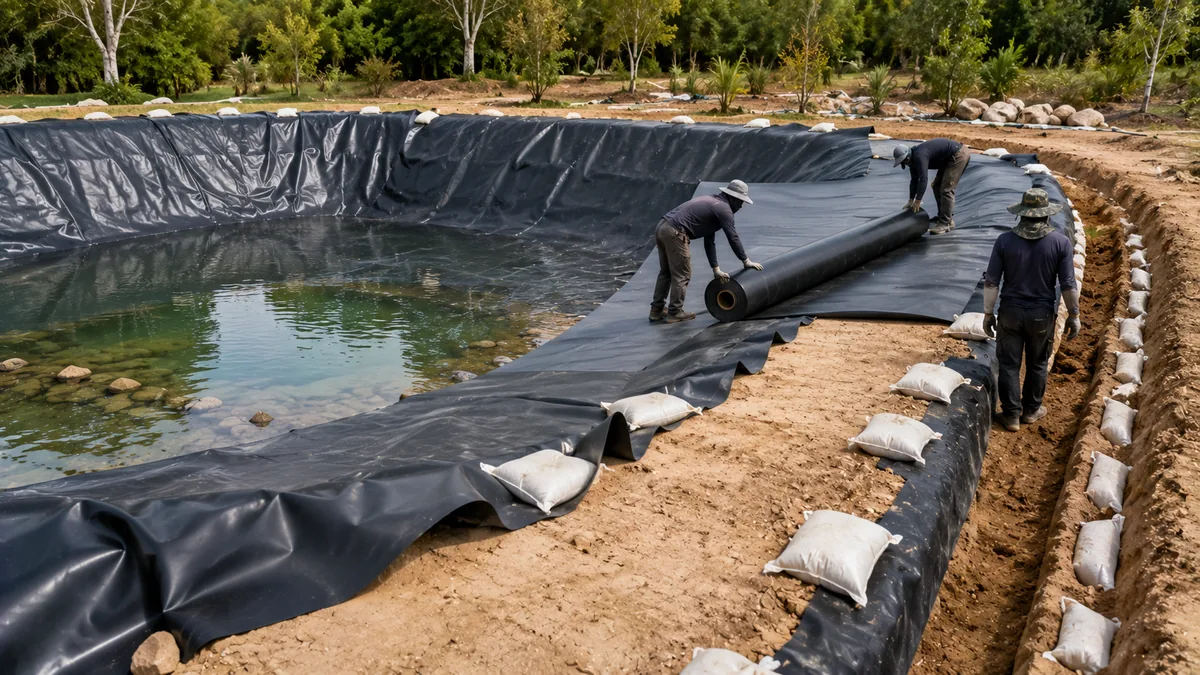
This is how a lined pond gets built, in the order it actually happens. It applies to a farm irrigation pond, an aquaculture basin or a landscape lake — the gauge changes, the sequence does not.
Measure the floor area, then measure the side slopes along the slope face rather than in plan — a 3 m deep basin at 1V:3H has nearly 9.5 m of sheet on each side, not 9 m. Add to that total:
A 50 × 30 × 3 m basin comes out around 2,200 m² wetted and about 2,600 m² of sheet ordered. Gauge for a farm pond is usually 1.0 mm, or 1.5 mm if the liner stays exposed and the head is significant.
This is the step that gets rushed and the step that causes the most failures. The base and slopes must be graded to profile, compacted, and cleared of stones, roots, debris and anything with an edge. Walk the whole basin and pick things out by hand — a 40 mm stone under two metres of water becomes a puncture eventually.
Side slopes should be no steeper than 1V:2H, and 1V:3H is more comfortable if the liner stays exposed. Round off internal corners while the machine is still there. It costs nothing now and saves a day of extrusion welding later.
A trench around the crest, typically 500 × 500 mm, set back roughly a metre from the top of the slope. The liner runs over the crest, down the trench wall, along its base, and is backfilled and compacted. This is what holds the membrane against wind uplift and against the weight of the sheet hanging on the slopes.
Ponds terminated without an anchor trench — sheet simply weighted with blocks or buried in a shallow scrape — are the ones that peel off the slope in the first serious wind.
On clean graded sand with the stones removed, the membrane can go straight down. On gatch, gravel, crushed rock, reclaimed ground, or wherever the water will be deep, a nonwoven cushion geotextile of 300–500 g/m² goes between subgrade and liner. It is a small share of the project cost and it is the difference between a liner that lasts and one that develops pinholes slowly.
Plan the layout so seams run down the slope, not across it. Deploy in the cool part of the day, with a spreader bar rather than dragging the sheet, and ballast each panel with sandbags as it lands. Do not leave unballasted sheet on site over lunch, and do not deploy at all in strong wind.
Leave deliberate slack. HDPE deployed at 28 °C will be noticeably longer at 48 °C; a liner welded drum-tight in the morning will be straining at its anchors by afternoon and pulling out of the corners at night.
Overlaps get wedge-welded, with a trial weld tested before production starts. Every wedge seam is air-pressure tested through its channel; every extrusion weld and patch is vacuum-box tested. A pond is small enough that there is no excuse for skipping any of it — the whole test regime on a farm pond is a matter of hours.
Every pipe through the liner gets a fabricated HDPE boot, extrusion-welded to the sheet and clamped to the pipe with a stainless band and sealant. This is the single most common leak point on farm ponds, and almost all of it comes from pipes pushed through a slit in the sheet and taped.
Protect the inlet where water discharges onto the liner — a concrete splash pad or a sacrificial sheet prevents scour and abrasion. Provide a designed overflow, above the top water level and below the crest, so the basin cannot overtop and cut out the anchor trench. If a tractor or pump ever enters the basin, build a protected ramp.
Backfill the anchor trench and compact it. Then fill the pond reasonably promptly: an empty lined basin sitting through a summer takes far more UV and thermal cycling than one under water, and water ballast is the best protection a liner has.
Fill gradually rather than blasting in from a large pump, particularly on a first fill, so that the membrane settles into the subgrade evenly. Then walk the perimeter after a few days and check that nothing has pulled at the anchors.
Keep vehicles off the liner, keep sharp objects out of the basin, check the anchor trench after storms, and inspect the pipe boots annually. If the water level starts dropping faster than evaporation explains, investigate early — a small puncture found in month three is a patch, and the same puncture found in year three is a drained basin and a survey.
0.5–0.75 mm for decorative and aquaculture ponds, 1.0 mm for farm and irrigation ponds, and 1.5 mm where the liner is exposed with a significant depth of water or the contents are aggressive.
You can do the earthworks, the anchor trench and the ballasting. Welding needs the right machine and a trained operator — and, more to the point, testing. A basin bigger than one roll width has seams, and unwelded or untested seams leak.
An HDPE-lined pond built properly — correct gauge, cushion layer where needed, welded and tested seams, proper anchor trench — is a multi-decade asset. Most failures are premature and traceable to subgrade preparation or detailing, not to the sheet wearing out.
Need this specified for a real project? We line ponds and reservoirs as HDPE geomembrane suppliers working across the UAE — send the basin dimensions through the enquiry form and you will get a sheet take-off, a gauge recommendation and a price back.
Farm, aquaculture and landscape ponds lined and tested.
300–500 g/m² nonwoven to protect the membrane.
Seepage from an open channel is invisible. There is no leak to point at — just water that arrives at the far end in smaller quantity than it left.
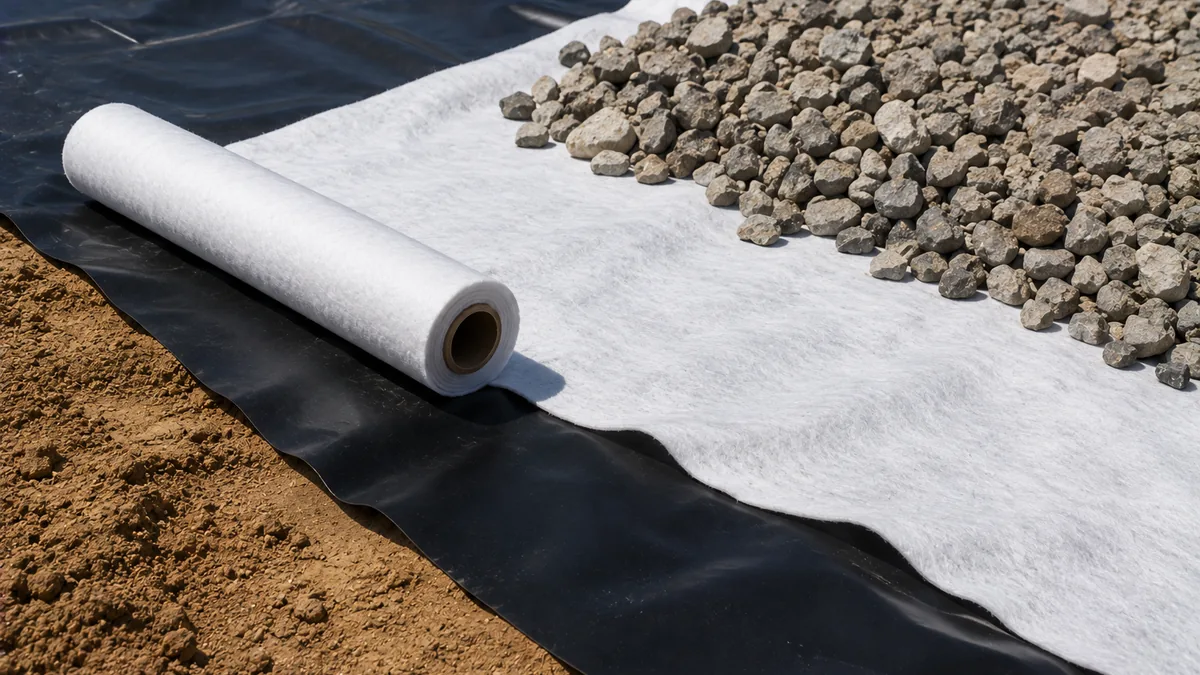
A landfill liner is not a sheet. It is a sequence of layers, each doing one job, and the interfaces between them decide whether the slope stands up.
Project enquiry
Send the dimensions and we will do the take-off, recommend a gauge and price the sheet delivered.